
Do acoustic curtains work? Laboratory-measured absorption and insulation
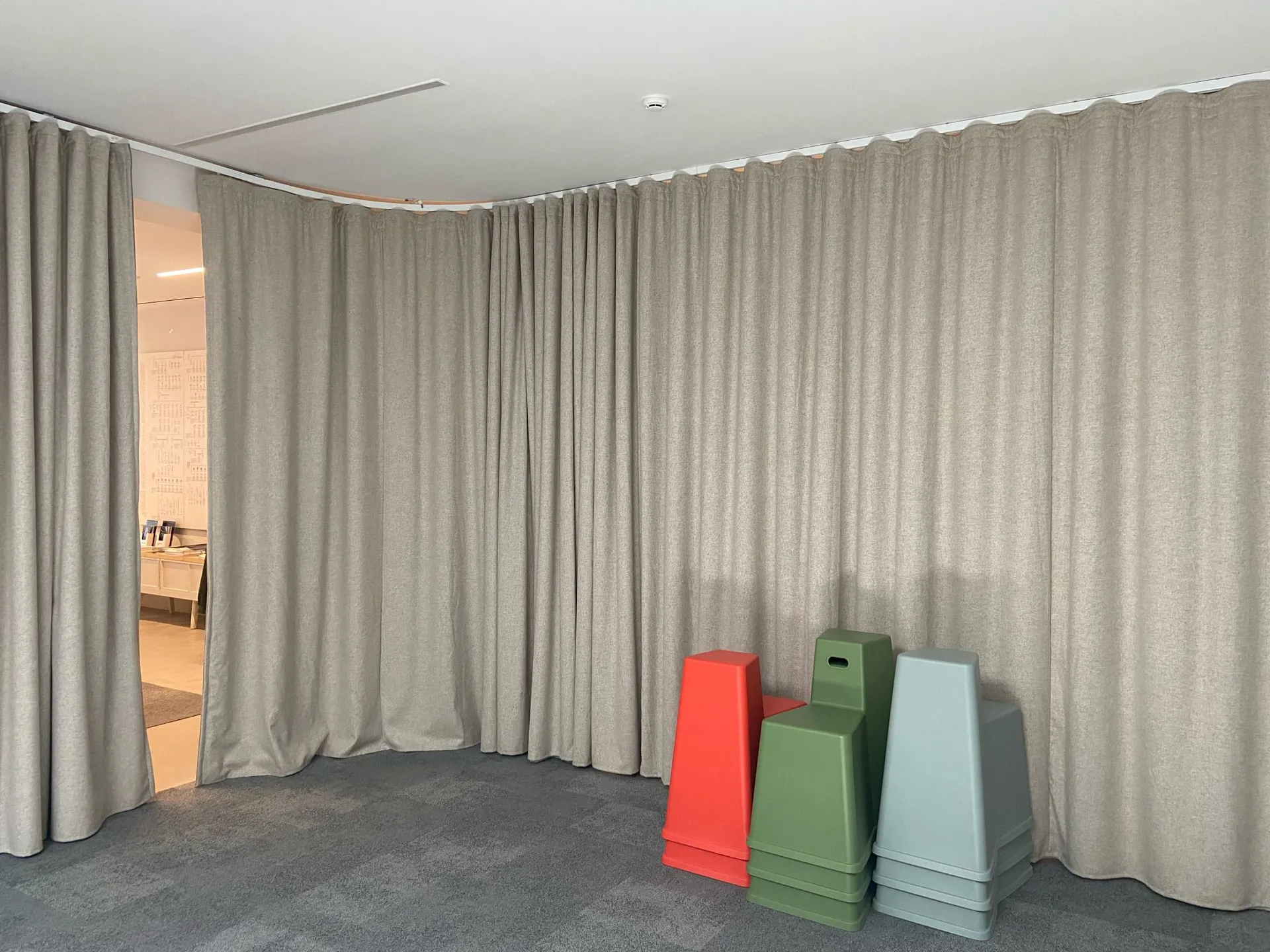
Quick answer: yes. An acoustic curtain removes the echo from the room (the 4-layer one absorbs almost all voice sound, αw 1.00) and also insulates: measured in the laboratory, the 4-layer ILUCS curtain reduces noise passing through it by 9 dBA and the 8-layer one by 17 dBA, with up to 56 dB in the highs.
Many people look for "soundproofing curtains" hoping to stop hearing the street or the next room. Here we show you the two things an acoustic curtain does, sound absorption and sound insulation, along with the laboratory curves of our curtains and roller blinds, and how to choose the one you need.
What does an acoustic curtain do?
In a room with hard surfaces (glass, concrete, drywall, tile flooring) sound bounces over and over again. That bounce is reverberation: the voice blends with itself, it is hard to understand speech, and the background noise goes up. An acoustic curtain is a fabric designed so that sound enters it and loses energy instead of bouncing. Less bounce means less reverberation, a clearer voice, and a quieter room.
It also has an advantage that a panel does not: it can be retracted. When it is not needed, it lets you see through the glass; when it is needed, it divides the room or covers the surface that bounces the most.
How much does it absorb? Laboratory curves
Sound absorption is measured in a reverberation room according to standard EN ISO 354 and is summarized in the αw coefficient (EN ISO 11654), from 0 (does not absorb at all) to 1 (absorbs everything). These are the values of our curtains and roller blinds, with their test report. The figures per frequency are the sound absorption coefficient in each band; values above 1 sometimes appear due to how it is calculated in the laboratory with pleated samples, and this is normal.
| Product and installation | 125 Hz | 250 Hz | 500 Hz | 1000 Hz | 2000 Hz | 4000 Hz | 5000 Hz | αw | Report |
|---|---|---|---|---|---|---|---|---|---|
| ILUCS CURTAIN · 1 layer · at 300 mm from the wall | 0.18 | 0.42 | 0.41 | 0.41 | 0.48 | 0.61 | 0.63 | 0.45 | TECNALIA 115541-3 |
| ILUCS CURTAIN · 2 layers · at 200 mm | 0.21 | 0.56 | 0.84 | 0.79 | 0.84 | 1.00 | 1.01 | 0.80 | TECNALIA 110259-6 |
| ILUCS CURTAIN · 4 layers · at 200 mm | 0.30 | 0.92 | 1.03 | 1.06 | 1.17 | 1.34 | 1.36 | 1.00 | TECNALIA B2019-LACUS-IN-54 V |
| IZZER CURTAIN · 1 layer · at 300 mm | 0.22 | 0.69 | 0.76 | 0.77 | 0.85 | 0.89 | 0.92 | 0.80 | TECNALIA 115541-2 |
| IZZER CURTAIN · 4 layers · at 200 mm | 0.32 | 0.92 | 1.07 | 1.03 | 1.10 | 1.26 | 1.29 | 1.00 | TECNALIA B2023-LACUS-IN-195-4 |
| PX500 CURTAIN · 1 layer · at 300 mm | 0.25 | 0.71 | 0.71 | 0.73 | 0.88 | 1.10 | 1.11 | 0.80 | TECNALIA 115541-1 |
| IZZER ROLLER BLIND · unrolled, at 100 mm | 0.06 | 0.18 | 0.51 | 0.77 | 0.52 | 0.64 | 0.66 | 0.50 | TECNALIA B2023-LACUS-IN-195-3 |
All curtains were tested pleated, with extra fabric, and spaced away from the wall. The roller blind was tested extended and flat.
What these figures tell us
- Layers count: the ILUCS CURTAIN goes from an αw of 0.45 with 1 layer to 0.80 with 2 and 1.00 with 4. Note: the 1-layer one was tested at 300 mm from the wall and the 2- and 4-layer ones at 200 mm, so they are not exactly the same setup.
- The fabric counts: a single layer of IZZER, made of merino wool, absorbs the same (αw 0.80) as two layers of ILUCS.
- In low frequencies (125 Hz) no curtain works miracles: between 0.18 and 0.32. For the low frequencies of a music room, other elements are needed.
- The roller blind, flat and glued to the window, absorbs mainly high and mid frequencies (0.77 at 1000 Hz) and little of the low frequencies. It is a good help, not the main solution.
Does an acoustic curtain also provide sound insulation?
Yes, and it is also measured in the laboratory, using another standard: sound insulation (EN ISO 10140-2, result according to EN ISO 717-1) indicates how many decibels sound loses when passing through the curtain. Sound absorption is removing reverberation inside the room; sound insulation is making less sound pass from one side to the other. Our multi-layer curtains do both.
| Curtain | 125 Hz | 250 Hz | 500 Hz | 1000 Hz | 2000 Hz | 4000 Hz | 5000 Hz | Rw | RA | Report |
|---|---|---|---|---|---|---|---|---|---|---|
| ILUCS CURTAIN · 4 layers | 4.3 | 4.1 | 6.3 | 7.5 | 9.8 | 12.3 | 13.7 | 9 dB | 9.0 dBA | TECNALIA B2021-LACUS-IN-146-5 |
| ILUCS CURTAIN · 8 layers | 9.2 | 9.3 | 9.8 | 17.7 | 36.1 | 51.7 | 56.2 | 16 dB | 17.0 dBA | TECNALIA 118746-2 |
| IZZER CURTAIN · 4 layers | 5.0 | 4.3 | 5.0 | 7.5 | 9.6 | 11.8 | 12.9 | 8 dB | 8.6 dBA | TECNALIA B2023-LACUS-IN-195-8 |
The figures by frequency are the sound reduction index R, in decibels. The 8-layer curtain reaches 56.2 dB at 5000 Hz: in the highs (voices, doorbells, cafeteria noise) it brakes tremendously; in the lows it brakes less, around 9-10 dB. In the test, the curtain was fixed around its entire perimeter and sealed: to approach these values, the edges must be closed tightly.
In practice: an 8-layer curtain serves to separate two zones of a room so that much less sound is heard from one to the other, or to block the passage of voices in a multi-purpose room. If the noise comes from outside and is mostly low-frequency (heavy traffic, machinery), the window and wall are still what matters most.
Where do they work best?
- Multi-purpose rooms and assembly halls: open or closed depending on use.
- Auditoriums and classrooms: in front of the most reflective walls.
- Offices and meeting rooms with extensive glass: they cover the glass when needed and let light through when not.
- Hotels and restaurants: to divide spaces without construction work.
How to choose your acoustic curtain
- Look at the problem: echo inside the room (absorb) or sound passing from one side to the other (insulate)? For the first, 1 to 4 layers are enough; for the second, 4 or 8 layers: the 4-layer one reduces 9 dBA and the 8-layer one, 17 dBA.
- Choose the absorption: for light help, 1 layer; for a room with a lot of echo, 2 or 4 layers, or a layer of IZZER.
- Leave air behind: the values in the table were measured with 200 or 300 mm between the curtain and the wall.
- Order extra fabric: absorption tests were done with the curtain pleated. A taut and flat curtain absorbs less.
- Check fire: the reaction to fire of each curtain is in the table below. In public spaces, check what the regulations require.
- Calculate the room: with the measurements and materials, "Calculate your room" tells you how much echo there is and how much it drops.
| Curtain | Reaction to fire |
|---|---|
| ILUCS CURTAIN | B-s1,d0 |
| PX500 CURTAIN | B-s1,d0 |
| IZZER CURTAIN | C-s1,d0 |
Frequently asked questions
Are acoustic curtains the same as blackout curtains?
No. A blackout curtain blocks light; an acoustic curtain is made to absorb sound, and its absorption is measured in a laboratory. Always request the test report.
How many layers do I need?
It depends on how much echo the room has and how much surface area you are going to cover. As a guide: 1 layer of ILUCS absorbs αw 0.45; 2 layers, 0.80; 4 layers, 1.00. One layer of IZZER, 0.80.
How much does an acoustic curtain insulate?
Laboratory measured: the 4-layer ILUCS CURTAIN, RA 9.0 dBA; the 8-layer one, RA 17.0 dBA, with up to 56.2 dB at 5000 Hz; the 4-layer IZZER CURTAIN, RA 8.6 dBA.
How are they sold?
They are custom-made and sold by the square meter.
Where can I see the reports?
In each curtain's data sheet and under Documentation → Laboratory Tests, with its report number.
Tags: sound absorption
/noticias/cortinas-acusticas-funcionan/