
How many acoustic panels do I need? The step-by-step calculation, with two examples
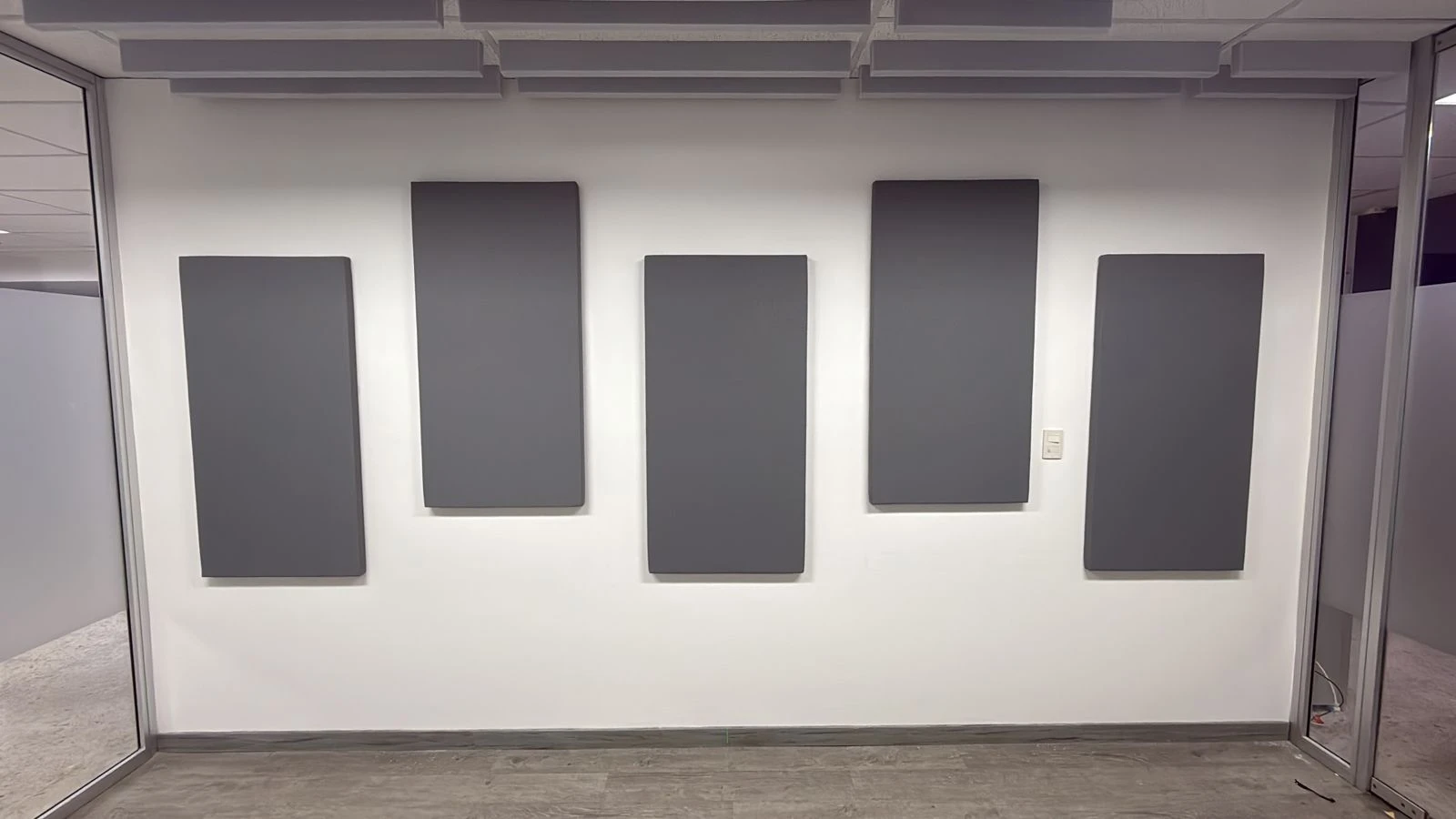
Quick answer: the number of panels comes from a three-step calculation: how much absorption the room lacks, how many square metres of panels provide that absorption, and how many pieces of the chosen format add up to those square metres. For example, an 8 × 6 m classroom that currently has 1.5 s of reverberation needs about 27 panels of 1220 × 610 mm to drop to 0.7 s; a 15 × 10 m restaurant that has 1.8 s needs about 32 panels of 1220 × 1220 mm to drop to 0.9 s.
What you need to know about your room
- Volume: length × width × height, in cubic metres.
- Current echo level: how long the sound takes to die away (reverberation time, T), in seconds. You don't need a meter: «Calculate your room» estimates this based on dimensions and materials.
- Target level: in Spain, the CTE sets the maximum for classrooms and conference rooms under 350 m³ and for dining halls with the room empty; in other rooms, the more important it is to understand speech, the shorter the time should be.
How to calculate how many acoustic panels you need
If you don't want to do the calculations, "Calculate your room" does them for you. If you want to understand them, there are three:
- Missing absorption: A = 0.16 · V · (1/target T − 1/today's T), in m² (CTE DB-HR formula, section 3.2).
- Square metres of panel: A divided by the panel's αw (absorption coefficient, from 0 to 1, measured in a laboratory).
- Number of panels: the square metres of panel divided by the surface area of a single panel, rounded up.
Example 1: a classroom
- 8 × 6 m classroom, 3 m high: V = 144 m³.
- Let's assume that today, empty, it is 1.5 s. The Spanish CTE requires a maximum of 0.7 s for an empty classroom.
- Missing absorption: 0.16 × 144 × (1/0.7 − 1/1.5) = 17.6 m².
- With 40 mm adhesive IZZER panel (αw 0.90): 17.6 / 0.90 ≈ 19.6 m² of panel.
- With 1220 × 610 mm panels (0.744 m² each): 19.6 / 0.744 ≈ 26.3, i.e. 27 panels.
Example 2: a restaurant
- 15 × 10 m dining hall, 3 m high: V = 450 m³.
- Let's assume that today, empty, it is 1.8 s. The Spanish CTE requires a maximum of 0.9 s for an empty dining hall.
- Missing absorption: 0.16 × 450 × (1/0.9 − 1/1.8) = 40.0 m².
- With 40 mm adhesive ILUCS panel (αw 0.85 (H)): 40.0 / 0.85 ≈ 47.1 m² of panel.
- With 1220 × 1220 mm panels (1.488 m² each): 47.1 / 1.488 ≈ 31.7, i.e. 32 panels.
What percentage of the room needs to be covered?
Many guides give a fixed percentage. It is not valid for all rooms, because it depends on the volume and the starting echo, but it serves to check the calculation:
| Room | Panel required | Reference surface area | Percentage |
|---|---|---|---|
| Example 1 classroom | 19.6 m² | walls, 84 m² | 23 % |
| Example 1 classroom | 19.6 m² | ceiling, 48 m² | 41 % |
| Restaurant from example 2 | 47.1 m² | ceiling, 150 m² | 31 % |
Panel dimensions: surface area of each format
To convert square metres to panels, here is the surface area of some 40 mm formats from the price list:
| Format (mm) | Surface area of a panel |
|---|---|
| 400 × 400 | 0.160 m² |
| 610 × 610 | 0.372 m² |
| 800 × 800 | 0.640 m² |
| 1220 × 1220 | 1.488 m² |
| 1220 × 400 | 0.488 m² |
| 1220 × 610 | 0.744 m² |
The same square footage can be distributed across large pieces or many small ones: the number of pieces changes, but the absorption changes very little.
Why low frequencies must be checked
The αw summarizes absorption in a single number, but a panel does not absorb equally at all frequencies. This is the laboratory-measured practical octave coefficient αp of two of our 40 mm panels:
| Panel | 125 Hz | 250 Hz | 500 Hz | 1000 Hz | 2000 Hz | 4000 Hz | αw | Report |
|---|---|---|---|---|---|---|---|---|
| IZZER, adhesive | 0.15 | 0.60 | 1.00 | 1.00 | 1.00 | 1.00 | 0.90 | TECNALIA B2021-LACUS-IN-146-3 |
| ILUCS, adhesive | 0.15 | 0.55 | 1.00 | 1.00 | 1.00 | 1.00 | 0.85 (H) | TECNALIA B2018-LACUS-IN-27 II |
At 125 Hz they absorb little. If the room's problem lies in the low frequencies (a music room, a gymnasium with high volume), the calculation using αw falls short and you have to calculate band by band, which is what "Calculate your room" does. On the other hand, the CTE uses the average of 500, 1000 and 2000 Hz when known: with these panels it is 1.00, higher than the αw, so the above calculation stays on the safe side.
Mistakes when counting panels
- Putting up "a few" by eye: if there are too few, the room still sounds the same; if there are too many, it sounds dead.
- Using a panel without testing: without its measured αw, you cannot know how many are needed.
- Putting them all together on a single wall: distribute them between the ceiling and one of the facing walls.
- Mixing installations: a panel hanging from the ceiling does not absorb the same as a glued one (the 40 mm ILUCS hanging has an αw of 0.80). Use the αw for the installation method you are going to use.
- Putting them on a surface that already absorbs, such as an acoustic ceiling: what they add is much less than the calculation says.
- Confusing echo with noise coming from outside: we explain this in "How to remove echo from a room".
Frequently asked questions
And in a meeting room?
The Spanish CTE does not set a limit for meeting rooms. Since understanding speech is what matters in them, it is advisable to stay below the values for a classroom; the shorter the target, the more panels are needed.
Do ceiling panels count the same as wall panels?
Yes, if the installation is the same: what counts is the square metres of absorption. Distributing them between the ceiling and the walls works better than putting them all in one place.
What about in a studio or home cinema?
Where do I calculate my room?
- In "Calculate your room": using the dimensions and materials, it tells you how much echo there is, band by band, and how much it drops with each product.
- If you prefer us to do it for you, ask us for a quote providing the dimensions and a few photos of the room.
Tags: sound absorption
/noticias/cuantos-paneles-acusticos-necesito/