
First reflection points: the mirror trick to know where to place panels
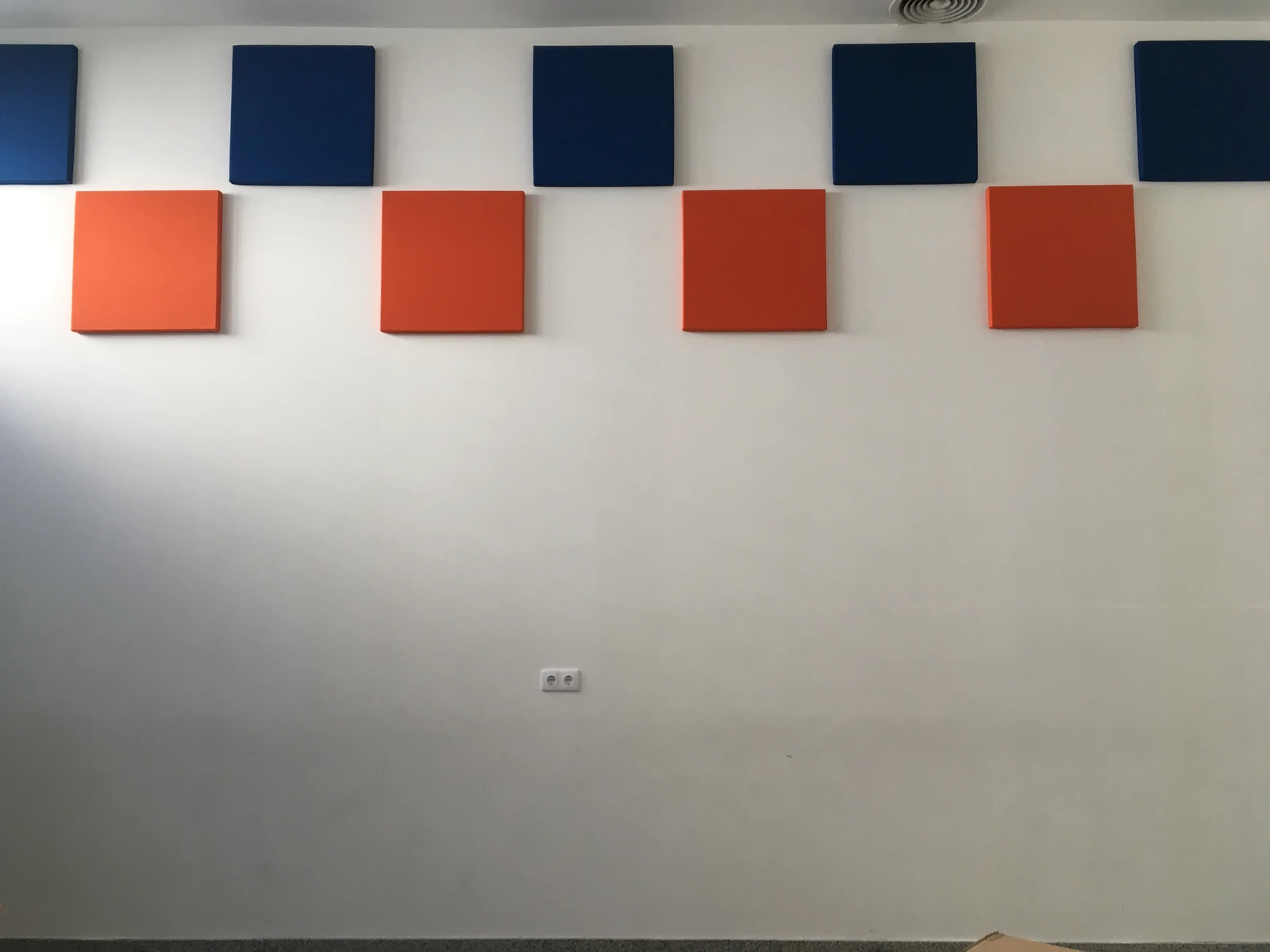
Quick answer: first reflection points are located with a mirror, and a first reflection is the sound from the speaker bouncing off a wall, ceiling, or floor just once before reaching your ears. To find where it falls, sit in your spot and have someone slide a mirror along the wall: wherever you see the speaker reflected, that is where the panel goes. Sound-absorbing material is placed on the side walls and ceiling; on the rear wall, if it is far away, a diffuser.
What is a first reflection?
From each speaker, direct sound reaches you first in a straight line. An instant later, copies arrive that have bounced once off the closest surfaces: the two side walls, the ceiling, the floor, and the front wall. These are the first reflections.
They arrive so closely timed with the direct sound that the ear cannot distinguish them as a separate echo, fusing them with the original signal. This acoustic blending creates noticeable effects:
- The stereo image becomes smeared: vocals are no longer locked in the center and instruments lack precise placement.
- The sound coloration changes: certain frequencies are boosted while others drop out, depending on the distance to the wall.
- At a mixing console or recording desk, what you hear is not what was recorded, leading to flawed decisions.
You do not need to treat the entire wall: targeting the points where each first reflection hits is enough. Finding them is precisely what the mirror does.
How is the mirror trick done?
You will need a hand mirror, a second person, and a way to mark the wall without damaging it, such as painter's tape. Speakers and seating must already be in their final positions.
- Sit in your listening position, with your head at your usual height.
- Have your assistant hold the flat mirror against the side wall, at ear height, between you and the speakers.
- Have them slide it slowly along the wall while you look at the mirror without moving your head.
- When you see the speaker on the same side in the mirror, stop and mark that point: it is the first reflection point for that speaker.
- Have them keep sliding it until you see the speaker on the opposite side, and mark it again. There are two points on each side wall.
- Repeat on the other side wall.
- Do the same on the ceiling: your assistant holds the flat mirror against the ceiling from a ladder and moves it until you see each speaker.
- If the wall behind you is clear, repeat there: you will see where the sound reflects back toward your head.
Each mark is the center of a panel. Since you will not always sit in the exact same spot, it is better to use a panel that covers the mark with a margin rather than an exact fit.
In the mirror, look at the tweeter, the smallest speaker in the cabinet. And if you move the speakers or the armchair, the marks move with them: repeat the trick.
What goes at each point?
It depends on the surface. On side walls and the ceiling, reflection arrives very close to the direct sound, and what works is eliminating it: sound-absorbing material. On the back wall, if far away, reflection arrives later, and there it is better to distribute it with a diffuser so as not to deaden the room.
| Point | What to install | ISINAC piece | αw (tested) |
|---|---|---|---|
| Side walls | Thick sound absorber | HÍBRIDO on the wall | 1.00 · TECNALIA B2019-LACUS-IN-83 I |
| Side walls, with no room for a thick panel | Absorbent panel | 40 mm adhesive ILUCS panel | 0.85 (H) · TECNALIA B2018-LACUS-IN-27 II |
| Ceiling | Absorbent panel | 40 mm adhesive ILUCS panel | 0.85 (H) · TECNALIA B2018-LACUS-IN-27 II |
| Front wall, between the speakers | Thick sound absorber | WB HP on the floor | 1.00 · TECNALIA 110259-7 |
| Back wall, far from you | Diffuser | 4×4 DIFFUSER or 14×7 DIFFUSER | Not applicable: it is a diffuser |
| Back wall, right behind you | Thick sound absorber | HÍBRIDO on the wall | 1.00 · TECNALIA B2019-LACUS-IN-83 I |
The αw summarizes in a single number what a panel absorbs, from 0 to 1, as measured in a laboratory. But in a listening room, the frequencies at which it absorbs also matter:
| Piece | 125 Hz | 250 Hz | 500 Hz | 1000 Hz | 2000 Hz | 4000 Hz | Report |
|---|---|---|---|---|---|---|---|
| Adhesive ILUCS panel 40 mm, surface-mounted | 0.15 | 0.55 | 1.00 | 1.00 | 1.00 | 1.00 | TECNALIA B2018-LACUS-IN-27 II |
| HÍBRIDO, on the surface | 0.50 | 0.95 | 1.00 | 0.95 | 0.95 | 0.90 | TECNALIA B2019-LACUS-IN-83 I |
| WB HP 140 mm, standing on the floor against the wall | 0.65 | 0.95 | 1.00 | 1.00 | 1.00 | 1.00 | TECNALIA 110259-7 |
It is the practical coefficient αp per octave. From 500 Hz upwards, all three pieces absorb 1.00 or close to it: for speech and instruments, any of them eliminates reflection. At 125 Hz, the 40 mm panel stays at 0.15 and HÍBRIDO reaches 0.50. For this reason, on side walls—if space allows—HÍBRIDO is better; on the ceiling, where a thick piece is impractical, use the 40 mm panel.
- Panels for walls, in Walls.
- Panels for ceilings, in Ceilings.
- HÍBRIDO, WB HP, and diffusers, in Studio and HIFI.
And the floor?
The floor also creates a first reflection between the speakers and you. A panel is not glued there: the usual approach is a thick rug in that area. If you want to check where it falls, a mirror leaning on the floor works the same way.
What the mirror trick does not solve
- Low frequencies: first reflections are noticeable mostly in vocals and instruments. Low frequency rumbles are treated in corners with bass traps.
- General room echo: if the whole room sounds like an empty hallway, distributed sound absorption is missing, not just at these points.
- What is heard outside: absorbing reflections improves how the room sounds inside; it does not insulate from neighbors.
- Which piece goes in each spot of a listening room, including bass: “HIFI listening room and home studio”.
- How much echo your room has and how much it drops with each panel: “Calculate your room”.
- In a small room, what comes first: “Do I need diffusers in a small room?”.
- Where to place panels in any room: “Where to place acoustic panels”.
Our pieces for this
Frequently asked questions
Does the trick work with a single speaker or a home cinema?
Yes. With a single speaker, there is one point on each surface; with multiple speakers, one for each speaker. In a home theater, this is repeated for every front speaker.
Sound-absorbent or diffuser on side walls?
In a home listening room, sound-absorbing: side walls are usually close and the reflection arrives very close to the direct sound. The HÍBRIDO is designed to combine sound-absorbing and diffuser features in one piece; its laboratory test is for absorption.
Can the panels be removed if I move the speakers?
The adhesive panel is designed to stay permanently: it cannot be peeled off to be repositioned. If you plan to move your equipment, a portable unit like the WB HP (floor-standing) or the HÍBRIDO is a better choice.
Tags: sound absorption
/noticias/primeras-reflexiones-truco-espejo/