
Where to place acoustic panels: wall, ceiling or suspended islands
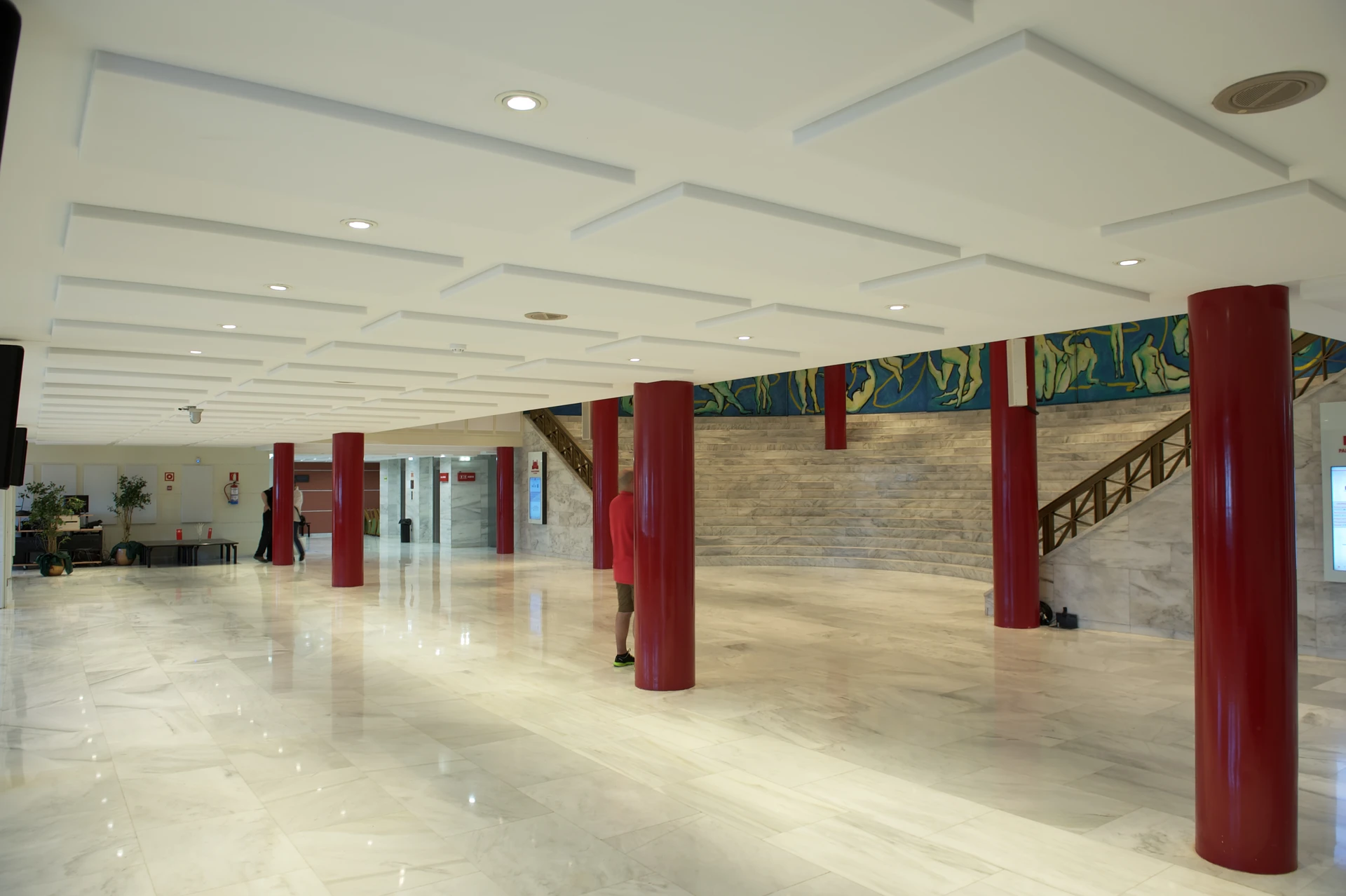
Quick answer: start with the ceiling. In classrooms up to 350 m³, restaurants, and dining rooms, the Technical Building Code allows removing echo using only a sound-absorbent ceiling, provided it absorbs enough. If that is not enough, add panels on the walls, distributed so there is absorption in the three directions of the room (ceiling, long walls, and short walls), and never all on a single wall: in an example from standard UNE-EN 12354-6, covering a single wall yields 0.5 s with a simple calculation, but part of the sound continues to resonate for 2.34 s. And if the ceiling cannot be touched or is very high, hang islands: our IZZER pleated hanging acoustic island gives αw 0.90 in its test.
Where are acoustic panels placed?
There are three locations, and in most rooms they are combined:
- Ceiling: it is the largest surface area and the least obstructive. It is not covered by furniture or pictures, it does not get knocked, and it takes up no wall space. Glued panel, suspended, or in islands.
- Walls: when the ceiling alone cannot provide all the required sound absorption, or when the ceiling is already sound-absorbent and the walls are causing reflections. Better distributed between long and short walls.
- Suspended islands: elements hung from the ceiling, with an air gap above. Useful when the ceiling is very high, has exposed services, or cannot be touched.
- In a studio or home cinema, it also matters where sound from the loudspeakers reflects first (first reflections), where panels are combined with diffusers. You will see this under Studio and HIFI.
What does the standard say about distributing the panels?
Two standards cover this, and their requirements align:
| Standard | What it says |
|---|---|
| CTE DB-HR, section 3.2.3 (simplified method) | In classrooms with a volume up to 350 m³, restaurants, and dining rooms, a uniform sound-absorbing treatment applied solely to the ceiling is suitable in most cases. |
| CTE DB-HR, section 3.2.3 | If there is no ceiling with the necessary sound absorption, sound-absorbent treatments must be added to the rest of the surfaces. |
| UNE-EN 12354-6, Annex D | If sound absorption is unevenly distributed (for instance, entirely on the ceiling or on a single wall), a simple reverberation time calculation may fail. |
UNE-EN 12354-6 illustrates this with a solved example in its Annex E: a 4.54 × 2.73 × 2.40 m room with a concrete floor and ceiling, brick walls, and a glass facade. Almost an entire long wall is covered with an absorber and the reverberation time at 1000 Hz is calculated:
| Annex E case (UNE-EN 12354-6) | Reverberation time at 1000 Hz |
|---|---|
| Empty room of 4.54 × 2.73 × 2.40 m | 2.1 s |
| A long wall covered 90% with an absorber of αs 0.85: simple math | 0.5 s |
| The same room: sound traveling parallel to the treated wall (Annex D) | 2.34 s |
| The same room: average of the four estimates from Annex D | 0.9 s |
The simple calculation says that the room drops to 0.5 s. But sound traveling parallel to that wall, bouncing between the floor, ceiling, and other walls, barely touches it, and keeps sounding for 2.34 s. The standard states that, since this time is much longer than the others, it is possibly the best estimate of what would be measured in the room. Moral: the same amount of absorber works much better distributed than concentrated on a single surface.
Surface-mounted, with an air cavity, or suspended? How sound absorption changes according to mounting
A panel does not absorb sound equally everywhere: it depends on how it is installed. That is why testing laboratories use standardized mountings (Annex B of EN ISO 354): glued directly to the surface, with an air cavity behind it (for example, at 400 mm), or, for curtains, positioned at a distance from the wall. These are our test results, with each respective mounting configuration:
| Product | Test setup | αw | αp at 125 Hz | Report |
|---|---|---|---|---|
| Adhesive ILUCS panel, 40 mm | Glued to the surface | 0.85 (H) | 0.15 | TECNALIA B2018-LACUS-IN-27 II |
| Suspended ILUCS panel, 40 mm | Suspended, 400 mm from the surface | 0.80 (H) | 0.20 | TECNALIA B2019-LACUS-IN-54 II |
| IZZER adhesive panel, 40 mm | Glued to the surface | 0.90 | 0.15 | TECNALIA B2021-LACUS-IN-146-3 |
| Exposed mineral foam (WHITE or GREY), self-adhesive, 20 mm | Attached to the surface | 0.40 (MH) | 0.05 | TECNALIA 110259-2 |
| Exposed mineral foam (WHITE or GREY), self-adhesive, 40 mm | Attached to the surface | 0.75 (MH) | 0.15 | TECNALIA B2018-LACUS-IN-27 III |
| Exposed mineral foam (WHITE or GREY), 40 mm | Suspended, 400 mm from the surface | 0.65 (MH) | 0.15 | TECNALIA B2019-LACUS-IN-54 I |
| Exposed mineral foam (WHITE or GREY), self-adhesive, 60 mm | Attached to the surface | 1.00 | 0.30 | TECNALIA 110259-1 |
| TENS-TEX ILUCS, 15 mm | On the surface | 0.50 (MH) | 0.05 | TECNALIA B2023-LACUS-IN-195-7 |
| WB (ILUCS, 33 mm) | With air cavity, at 400 mm from the surface | 1.00 | 0.35 | TECNALIA 110259-5 |
| WB IMECO (IZZER, 33 mm) | With air cavity, at 400 mm from the surface | 0.80 (H) | 0.30 | TECNALIA 110259-4 |
| Pleated hanging acoustic island IZZER | Elevated to 2150 mm from the chamber floor | 0.90 | 0.45 | TECNALIA 126374-2 |
What the table shows:
- With ILUCS, suspending a 40 mm panel retains sound absorption very similar to bonding it directly: ILUCS achieves 0.80 (H) suspended and 0.85 (H) bonded, while suspended gains slightly at 125 Hz (0.20 versus 0.15). For this reason, suspended panels are the ideal way to treat a ceiling without bonding or drilling the entire surface.
- Thickness is the factor that most affects low frequencies in a bonded panel: mineral foam goes from 0.05 at 125 Hz with 20 mm to 0.15 with 40 mm and 0.30 with 60 mm, with its αw moving from 0.40 (MH) to 0.75 (MH) and 1.00.
- Products engineered to operate with an air gap absorb the most low frequencies in the table: WB at 400 mm achieves 0.35 at 125 Hz, and the IZZER pleated acoustic hanging island achieves 0.45.
- Each value applies to its specific mounting method. If you intend to suspend, use the suspended rating; if you intend to bond directly, use the bonded rating.
The same applies to curtains, blinds and WATER LILY: they are tested with an air gap behind them, at the distance at which they will be installed.
| Product | Test setup | αw | Report |
|---|---|---|---|
| ILUCS CURTAIN, 1 layer | Draped, at 300 mm from the wall | 0.45 (H) | TECNALIA 115541-3 |
| ILUCS CURTAIN, 2 layers | Folded, 200 mm from the wall | 0.80 (H) | TECNALIA 110259-6 |
| ILUCS CURTAIN, 4 layers | Folded, 200 mm from the wall | 1.00 | TECNALIA B2019-LACUS-IN-54 V |
| IZZER CURTAIN, 1 layer | Draped, at 300 mm from the wall | 0.80 | TECNALIA 115541-2 |
| BLIND (IZZER) | Unrolled, 100 mm from the wall | 0.50 (MH) | TECNALIA B2023-LACUS-IN-195-3 |
| WATER LILY (Ø 910 × 7 mm) | Suspended, with 400 mm of air gap | 0.80 (H) | TECNALIA 110259-8 |
Acoustic panels on the ceiling or on the wall?
If the mounting system is the same, one square meter of panel absorbs the same on the ceiling as it does on the wall: what counts in calculating reverberation is the absorption square meters. What changes is where they fit and how they are distributed:
- Ceiling first: it is large, clear and in many rooms it is enough, as allowed by the CTE for classrooms, restaurants and dining halls.
- Walls next, if the ceiling is not enough or is already acoustic. Distribute them so that there is absorption in all three directions of the room: ceiling, long walls and short walls. If all absorption is placed on facing walls, sound traveling in the other direction keeps bouncing.
- Never put everything on one wall: this is the case of the standard's example, which seems solved in the simple calculation but is not in the actual room.
- Hanging islands when the ceiling is high or cannot be touched: they work with air above them and, in our test, give the highest bass in the table.
Does an acoustic panel on the wall insulate against neighbor noise?
It must be stated clearly, because many people look for «wall sound insulation» and find panels: an acoustic panel absorbs. It eliminates echo inside the room, which is what its αw measures. Allowing less noise to pass through the wall is sound insulation, a different property, which is measured under another standard (EN ISO 10140-2, result according to EN ISO 717-1).
Some of our products do have both measurements: the multi-layer curtains. Tested with the perimeter fixed and sealed, these are their insulation results:
| Product | RA Insulation | Report |
|---|---|---|
| ILUCS CURTAIN, 4 layers | 9.0 dBA | TECNALIA B2021-LACUS-IN-146-5 |
| ILUCS CURTAIN, 8 layers | 17.0 dBA | TECNALIA 118746-2 |
| IZZER CURTAIN, 4 layers | 8.6 dBA | TECNALIA B2023-LACUS-IN-195-8 |
- We explain it in full in "Do acoustic curtains work?".
- And the difference between removing echo and blocking outside noise, in "How to remove echo from a room".
Decorative wall panels that also absorb sound
A wall acoustic panel is visible, so it also decorates. Our sound-absorbent wall coverings are chosen by shape, finish, and mounting system:
- Shapes: SQUARE, RECTANGLE, CIRCLE, ELLIPSE, HEXAGON, TRIANGLE, PILL, TRISMA, and LINEAR, which can be combined on the same wall.
- Finishes: WHITE and GREY (exposed mineral foam), ILUCS (Trevira CS polyester), and IZZER (merino virgin wool), available in numerous colors.
- Wooden frame panels: WB and WB IMECO.
- Seamless, custom-made surfaces: TENS-TEX, fabric stretched over a profile.
- Mounting options: adhesive (mounts without drilling on plasterboard, stone, concrete, and ceilings, following the assembly manual), magnetic, or suspended.
A tip for installing the adhesive panel: it does not stick to anti-mould or anti-grease paint, nor onto a wet surface. Before sticking, the support must be clean, dry and dust-free.
What panel placement cannot fix
- Noise coming from outside or from the adjacent room: that is insulation, not absorption.
- Low frequencies in a music room or a large gym using just a few centimeters of paneling: that requires thickness or an air gap behind, and checking absorption at 125 Hz, not just αw.
- Falling short: with too few square meters, no matter how well placed they are, the improvement is hardly noticeable.
- Installing panels on a ceiling that is already acoustic: what they add is much less than what the math suggests.
Mistakes when installing acoustic panels
- Placing them all on a single wall and leaving the ceiling and opposite wall untreated.
- Calculating with the αw of one mounting assembly and installing with another: use the data for the mounting assembly you are going to install.
- Hanging a curtain flush against the wall: our curtains were tested with 200 or 300 mm of air gap behind them.
- Gluing without preparing the substrate: it must be clean, dry, and dust-free.
- What αw, NRC, and sound absorption classes mean: "Sound absorption coefficient".
- For a music room or HIFI room: "First reflections: the mirror trick".
- Sound absorption guide.
Our pieces for this
Frequently asked questions
Can wall panels be hung from the ceiling?
How far from the wall should an acoustic curtain be installed?
With air behind: our curtains were tested at 200 and 300 mm from the wall, and their figures are valid for that distance.
Who installs the panels?
How do I know how many panels I need and where to place them?
Tags: sound absorption
/noticias/donde-colocar-paneles-acusticos/