
Recommended reverberation time: table by room and country
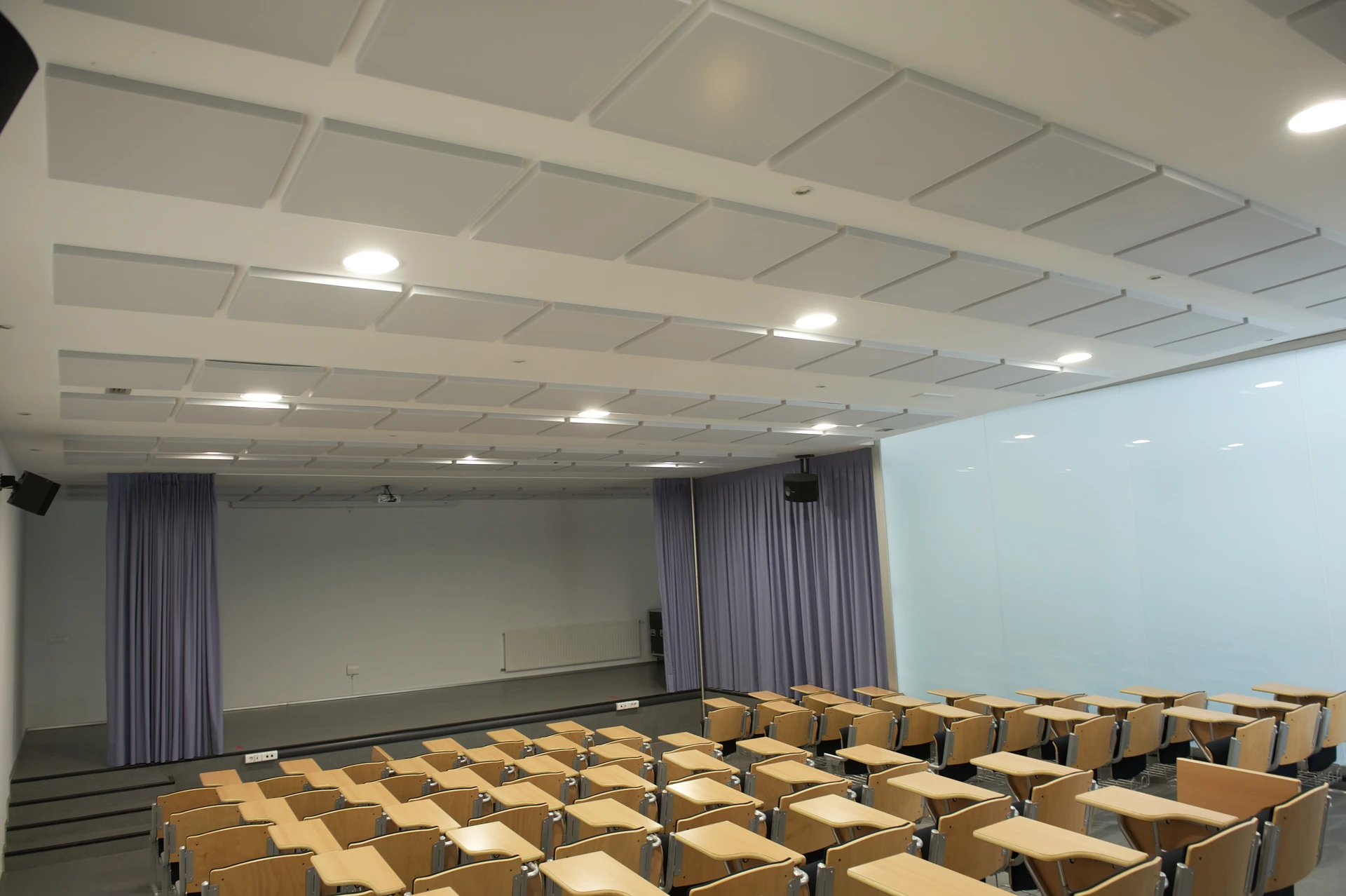
Quick answer: the recommended reverberation time for a classroom of about 150 m³ is a maximum of 0.6 to 0.8 seconds depending on the country (in Spain, 0.7 s with the room empty and unfurnished, or 0.5 s with all its seating), and for a dining hall, 0.8 to 1.2 seconds in standards that provide a fixed figure. These are the new build limits from freely available standards. Each country measures them under slightly different conditions, and Portugal calculates them using a formula based on volume. Below are the figures for Spain, England, France and Portugal, each with its corresponding standard.
What is reverberation time?
It is the time it takes for sound to fade away inside a room after it stops playing (specifically, to drop by 60 dB). It is measured in seconds. The longer it is, the more words blend together and the harder it is to understand speech. The regulations in England, France and Portugal compare it to the average of the 500, 1000 and 2000 Hz bands, and the Spanish CTE calculates it using those exact same bands.
How is it calculated?
The CTE (DB-HR, section 3.2) uses the formula T = 0.16 · V / A: V is the volume of the room in m³ and A is the equivalent absorption area in m² (the total absorption of all its surfaces combined). For example, an 8 × 6 × 3 m classroom has V = 144 m³; if its surfaces total A = 33 m² of absorption, T = 0.16 × 144 / 33 = 0.70 s, exactly the CTE limit for an empty classroom.
Classrooms and lecture halls
| Country and standard | Room | Maximum reverberation time | Condition |
|---|---|---|---|
| Spain · CTE DB-HR, art. 2.2 | Classroom or lecture hall under 350 m³ | 0.7 s | empty, without occupancy or furniture |
| Spain · CTE DB-HR, art. 2.2 | Classroom or lecture hall under 350 m³ | 0.5 s | empty, with all its seating |
| England · BB93 (2015), table 6 | Early years and primary classroom | 0.6 s | new build; furnished and unoccupied |
| England · BB93 (2015), table 6 | Early years and primary classroom | 0.8 s | refurbishment; furnished and unoccupied |
| England · BB93 (2015), table 6 | Secondary classroom | 0.8 s | new build; furnished and unoccupied |
| England · BB93 (2015), table 6 | Secondary classroom | 1.0 s | refurbishment; furnished and unoccupied |
| France · decree (arrêté) of 25 April 2003, education | Classroom up to 250 m³ | between 0.4 and 0.8 s | furnished and unoccupied |
| France · decree (arrêté) of 25 April 2003, education | Classroom over 250 m³ | between 0.6 and 1.2 s | furnished and unoccupied |
| Portugal · RRAE (DL 96/2008), art. 7 | Classroom, library, multipurpose room | 0.15 × cube root of V | furnished and unoccupied |
| Portugal · RRAE (DL 96/2008), art. 10-A | Lecture hall under 250 m³ | 0.12 × cube root of V | furnished and unoccupied |
Dining halls and restaurants
| Country and standard | Room | Maximum reverberation time | Condition |
|---|---|---|---|
| Spain · CTE DB-HR, art. 2.2 | Restaurant or dining hall | 0.9 s | empty |
| England · BB93 (2015), table 6 | School dining hall | 1.0 s | new build; furnished and unoccupied |
| England · BB93 (2015), table 6 | School dining hall | 1.5 s | refurbishment; furnished and unoccupied |
| France · decree (arrêté) of 25 April 2003, education | School dining hall up to 250 m³ | between 0.4 and 0.8 s | furnished and unoccupied |
| France · decree (arrêté) of 25 April 2003, education | School dining hall of more than 250 m³ | 1.2 s | furnished and unoccupied |
| France · decree (arrêté) of 25 April 2003, health | Hospital dining room up to 250 m³ | 0.8 s | furnished and unoccupied |
| Portugal · RRAE (DL 96/2008), arts. 6 and 7 | Restaurant, public dining hall or school dining hall | 0.15 × cube root of V | furnished and unoccupied |
Offices and meeting rooms
| Country and standard | Room | Maximum reverberation time | Condition |
|---|---|---|---|
| Spain · CTE DB-HR, art. 2.2 | Office or meeting room | does not set a time | only sets values for classrooms, conference rooms and dining halls |
| England · BB93 (2015), table 6 | School meeting room | 0.8 s | new build and refurbishment |
| England · BB93 (2015), table 6 | School office or staff room | 1.0 s | new build |
| England · BB93 (2015), table 6 | School office or staff room | 1.2 s | refurbishment |
| France · decree (arrêté) of 25 April 2003, education | Administration office, meeting room or school library | between 0.4 and 0.8 s | furnished and unoccupied |
| France · decree (arrêté) of 25 April 2003, health | Consulting room, medical office or bedroom up to 250 m³ | 0.8 s | furnished and unoccupied |
| France · decree (arrêté) of 25 April 2003, health | Staff rest room up to 250 m³ | 0.5 s | furnished and unoccupied |
| Portugal · RRAE (DL 96/2008), art. 6 | Office of 100 m³ or more | 0.15 × cube root of V | furnished and unoccupied |
Gymnasiums, sports halls and other rooms
| Country and standard | Room | Maximum reverberation time | Condition |
|---|---|---|---|
| Spain · CTE DB-HR, art. 2.2 | Gymnasium or sports hall | does not set a time | only sets values for classrooms, conference rooms and dining halls |
| England · BB93 (2015), table 6 | School gymnasium or activity room | 1.5 s | new build; empty room |
| England · BB93 (2015), table 6 | School gymnasium or activity room | 2.0 s | refurbishment; empty room |
| England · BB93 (2015), table 6 | Indoor sports pavilion or swimming pool | from 1.5 s (less than 280 m²) to 2.0 s (more than 530 m²) | new build; empty room |
| England · BB93 (2015), table 6 | School library | 1.0 s | new build; furnished and unoccupied |
| England · BB93 (2015), table 6 | Music classroom | 1.0 s | new build and refurbishment |
| France · decree (arrêté) of 25 April 2003, education | School gymnasium | does not set a time | the decree does not assign a value to it |
| Portugal · RRAE (DL 96/2008), art. 9 | Sports hall | 0.15 × cube root of V; with public address system, 0.12 × cube root of V | furnished and unoccupied |
The formula for Portugal, with examples
Portugal does not provide a fixed figure: the maximum is 0.15 multiplied by the cube root of the room volume V, in m³. This is how it works out for various volumes:
| Room volume | Maximum time (0.15 × cube root of V) |
|---|---|
| 100 m³ (a small office) | 0.70 s |
| 150 m³ (a classroom) | 0.80 s |
| 300 m³ | 1.00 s |
| 450 m³ (a 15 × 10 × 3 m restaurant) | 1.15 s |
| 3000 m³ (a sports hall) | 2.16 s; 1.73 s with PA system |
When checking the finished work, Portugal subtracts from the measured time an uncertainty margin of 25 % of the limit before comparing it.
Other countries: the standard you need to check
In other countries, or in other types of building, the figure is found in a technical standard that we do not summarise here. If your project is in one of them, the value comes from that standard: in Germany, DIN 18041 (2016); in the United States, ANSI/ASA S12.60 (classrooms); in Italy, UNI 11532-2 (schools) and UNI 11367 (other rooms), to which the 2022 environmental criteria decree for public works refers; in France, for offices, NF S 31-080; in Sweden, SS 25268; and in Norway, NS 8175.
How to compare figures properly?
- Check whether the room is measured empty or furnished: the Spanish CTE gives the figure without furniture (or only with seating); England, France and Portugal, with furniture in place, except for English gymnasiums, which are measured empty. Furniture lowers the time.
- Check whether it is a new build or refurbishment: England allows slightly more in refurbishment; French decrees are for new buildings, and the CTE does not apply to extensions or refurbishments, except for comprehensive retrofitting.
- Check whether it is a maximum or a range: France also requires a minimum in classrooms (0.4 s or 0.6 s), so that the room does not remain too dry.
- If the standard gives a formula, as in Portugal, calculate using your room's volume.
- BB93 is the standard for schools in England; do not simply apply it to the rest of the UK.
What does not lower the reverberation time?
How to reach the time required by your standard?
- Using the room's dimensions and materials, «Calculate your room» tells you how much echo there is and how much it drops with each product.
- The step-by-step calculation of how many panels are needed is in «How many acoustic panels do I need?».
Frequently asked questions
Is it mandatory to comply with these values?
Yes, in the buildings covered by each text, and above all in new builds: the CTE in Spain, BB93 in schools in England (which allows somewhat higher values in refurbishment), the 2003 decrees in new teaching and healthcare facilities in France, and the RRAE in Portugal.
What reverberation time is good for an office or a meeting room?
Outside schools and hospitals, out of the four countries only Portugal sets one, for offices of 100 m³ or more: using its formula, a 300 m³ office can reach 1.00 s. Within schools, England requires 0.8 s in meeting rooms and 1.0 s in offices, and France between 0.4 and 0.8 s. For any ordinary office, classroom values serve as a guide, because in both cases the important thing is to understand one another.
What about in a dwelling or a hotel?
Neither the CTE, nor the French decrees, nor the Portuguese RRAE set a reverberation time for dwellings or hotel rooms. What Spain and France do require is absorption in common areas: the CTE, at least 0.2 m² of absorption per each m³ in the common areas of residential and educational buildings that have doors opening to habitable rooms (DB-HR 2.2.2); France, in hotel corridors.
Why does France also require a minimum?
Because a room that is too dry is also not good for speaking and listening: the voice reaches the back with less force. That is why in its classrooms the time must stay within a range, not just below a maximum.
Tags: sound absorption
/noticias/tiempo-reverberacion-recomendado/